
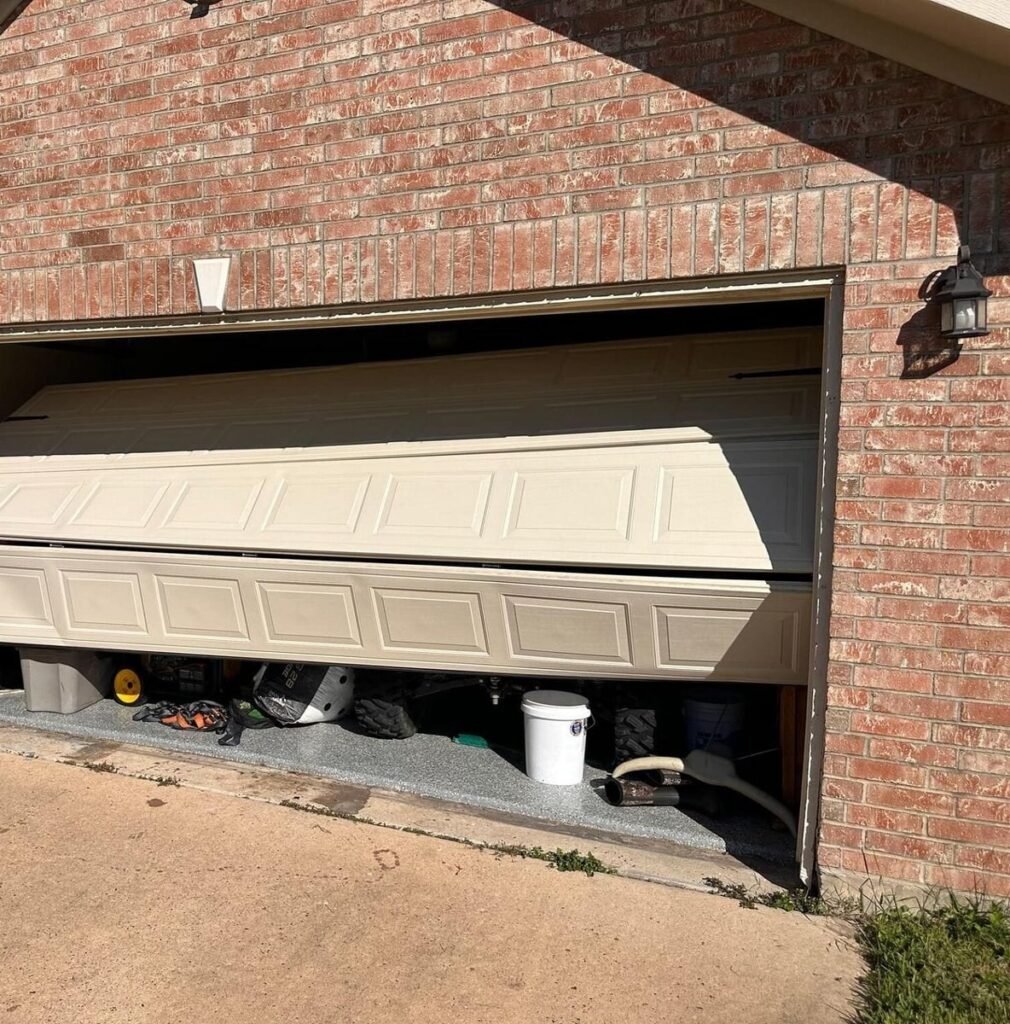
Why Won’t My Garage Door Open All the Way?
It goes up, stops short, and sits there. There’s a one-minute test that tells you whether you’re dealing with the opener or the door — and it saves you guessing at the wrong half of the problem.
The door starts up like normal. Then, somewhere between waist height and most of the way, it just — stops.
Maybe it sits there. Maybe it slides back down. Either way there’s not enough room to get the car out, and you’re standing in the driveway trying to decide whether this is a hit-the-button-again situation or a call-someone situation.
Before you do either, there’s a test worth a minute of your time.
First: the Hand Test
This one question splits the whole diagnosis in half, and you can answer it yourself.
With the door down, pull the red release cord hanging from the opener rail. That disconnects the door from the motor. Now lift the door by hand, slowly, all the way up.
- It runs smoothly and stays where you put it? The door, the tracks and the springs are all fine. Your problem is the opener — its limits or its force settings. Skip to that section.
- It binds, catches, gets stiff at a particular point, or feels enormously heavy? The problem is the door. No amount of adjusting the opener will fix it, and adjusting the opener is how people make it worse.
To reconnect afterwards, pull the cord back toward the door (or straight down, depending on the model) and run the opener once — it re-latches on the next pass.
Stopping Short Is Not the Same as Reversing
These get lumped together everywhere and they’re genuinely different faults. Which one you’ve got narrows things a lot.
A calm, confident stop
The door rises, stops cleanly at the same sort of height, and the opener acts like it’s finished. No straining, no reversing, light behaves normally. That confidence is the clue. The opener isn’t failing — it genuinely believes the door is open, because its up-travel limit is set too low.
Every opener has a limit setting for up and one for down. Older units use dials on the back of the motor housing; newer ones use a button sequence. They drift, and they get knocked. It’s one of the more satisfying fixes because nothing is actually broken.
A struggle, then a reverse
The door labours, slows, and rolls back down. That’s the opener meeting more resistance than its force setting permits, and giving up on purpose. Something is either physically in the way or the door has got heavy.
What’s Actually Causing It
A seized or flat-spotted roller
Rollers should spin freely. When a bearing dries out and seizes, the roller stops rolling and starts dragging, and the drag gets worse where the track curves. Classic tell: the door stops at exactly the same point every single time. Openers don’t usually fail at a repeatable position — hardware does.
A bent track section
Nudged by a bumper, leaned on by a ladder, dinged by a bike. A pinch in the track is often invisible until you look along it at eye level from the side. Same signature as a bad roller: it fails at the same height, every time.
Springs that have lost their tension
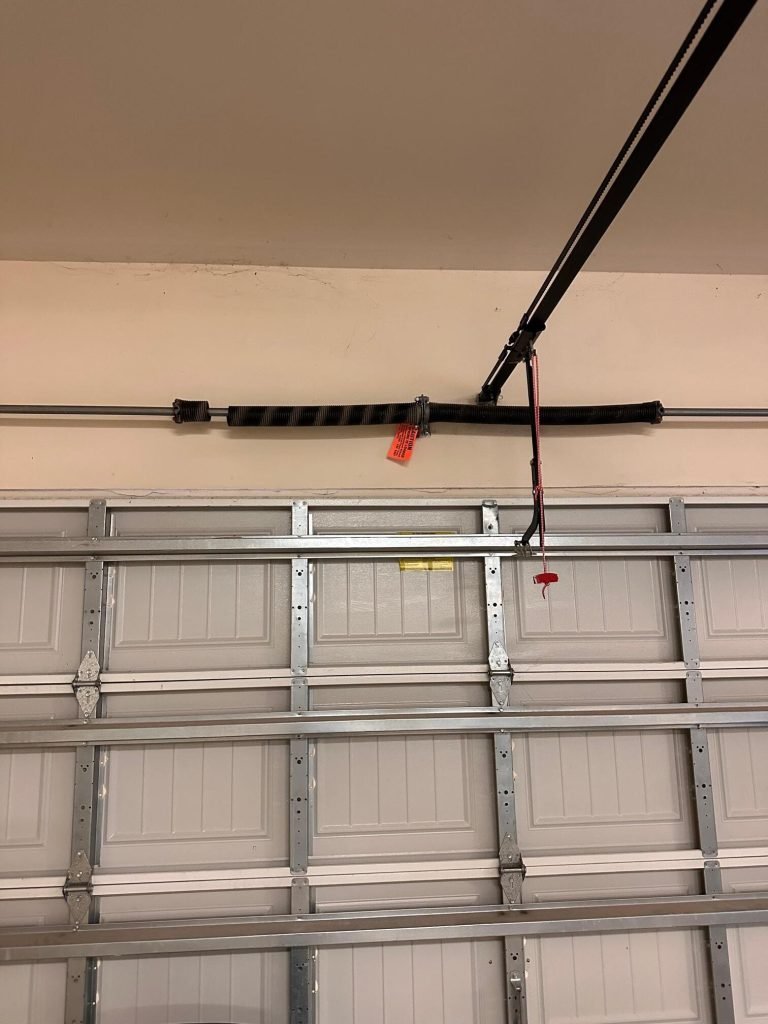
Springs do the lifting. The opener only guides. When a spring is weak or gone, the opener is asked to haul a 150-plus-pound door on its own, and it will manage a foot or two before its force limit trips. This one usually announces itself on the hand test — the door feels like lifting a fridge. If you see a clean gap of an inch or two in the coil on the bar above the door, that’s the whole diagnosis. More on broken springs here, and on why they fail when they do.
The door has shifted out of square
Around Fort Bend and the older parts of Houston, slabs move. When the opening racks slightly out of square, the door binds against one jamb on the way up. Usually gradual — it stiffens over months rather than failing overnight — and it often shows as scuffing down one side of the door.
August
Worth knowing here specifically. Metal expands, and the grease in rollers and hinges thins out and migrates in the heat. A track that’s a fraction tight in February can bind in a 110°F Katy garage in August. If the door misbehaves in the afternoon and behaves in the morning, that’s a mechanical clearance problem, not an electrical one.
How Much Can You Keep Trying?
Once or twice to work out what’s happening is fine. A week of it isn’t.
Every attempt where the opener strains against something puts that load through the top section of the door, the opener arm, and the bracket holding them together. That’s how a door that needed a roller becomes a door that needs a roller and a straightened bracket and a new top panel. And if the cause is a dead spring, repeated attempts are a good way to add a burnt-out opener to the list.
Diagnose it, then stop pressing.
Questions About a Door That Stops Short
+Why does my garage door only open part way?
A door that starts up and stops short is usually telling you one of four things: the opener's up-travel limit is set too low, so it thinks it has finished; something is physically stopping the door in the track, typically a bent section of track or a seized roller; the springs have lost tension and the opener is hitting its force limit partway up; or the opener's force setting has drifted and it is quitting early. The way the door stops tells you which one — a smooth clean stop points at settings, a struggle or a jolt points at the door.
+What is the up-travel limit on a garage door opener?
It is the setting that tells the opener how far to run before stopping. Every opener has one for up and one for down, adjusted either with dials on the back of the motor unit or through a button sequence, depending on the model. If the up limit drifts or gets knocked, the opener stops the door short and considers the job done — no straining, no reversing, it just stops and the light behaves normally. That calm, confident stop is the giveaway that it is a setting rather than a fault.
+Why does my garage door stop and reverse instead of opening?
Reversing on the way up is different from stopping short, and it usually means the opener is meeting more resistance than its force setting allows. Common causes are a roller that has seized in the track, a bent track section, a door that has shifted out of square, or springs that no longer carry the weight so the opener is doing too much of the lifting. Because the force setting exists to stop the door crushing something, turning it up to force past the problem is exactly the wrong response.
+Can a broken spring make the door open only part way?
Yes, and it is one of the more common versions of this. With a spring gone or weak, the opener is trying to lift the full weight of the door on its own — a two-car steel door is well over 150 pounds. It will typically strain, lift the door a few inches to a couple of feet, then stop or reverse. The tell is that the door is also very heavy to lift by hand once the opener is released, and on a failed torsion spring you will see a clean gap in the coil on the bar above the door.
+How do I know if it is the track or the opener?
Pull the red release cord to disconnect the opener, then lift the door by hand slowly. If it runs smoothly all the way up and stays where you leave it, the door and its hardware are fine and the problem is the opener's settings or force. If it binds, catches, gets stiff at a particular point, or wants to fall, the problem is in the door itself and no amount of opener adjustment will fix it. That one test splits the diagnosis in half and takes about a minute.
+Why does my garage door stop at the same spot every time?
Stopping at the identical point on every attempt points at something physical at that point in the travel — a dent or bend in the track, a roller that binds where the track curves, a bracket that has worked loose, or debris in the track. Openers do not usually fail at a repeatable position. If instead the stopping point varies from one attempt to the next, that leans toward spring tension or a force setting on the edge of tripping.
+Does cold or heat affect how far the door opens?
Around Houston, heat is the version you meet. Metal expands, grease in the rollers and hinges thins and migrates, and a track that is a fraction tighter in August can be enough to bind a roller that was fine in February. Doors that only misbehave in the hottest part of the afternoon and run properly in the morning are worth looking at as a mechanical clearance problem rather than an electrical one.
+Is it safe to keep using a door that will not open fully?
Using it occasionally to get a car out is not the risk; repeatedly forcing it is. Every attempt where the opener strains against something puts load through the top section of the door, the opener arm and the bracket that holds it, which is how a stuck door becomes a bent panel or a pulled bracket. If the door is stopping because a spring is gone, keep pressing and you can add a burnt-out opener to the job. One or two tries to diagnose it is fine. A week of them is not.
Did the Hand Test and It Binds?
Then it’s the door, not the opener. Free estimate, no service-call charge, and a straight answer on how soon we can be there.