Garage Door Opener Repair & Replacement
Dead unit, humming motor, a door that starts down and changes its mind. Most opener faults are one cheap part, and we’ll tell you which one before you spend anything on a new machine.
What Is It Doing?
Opener faults are unusually easy to narrow down from the symptom. Find yours.
Nothing at all — no lights, no hum
Dead as a stone from the remote and the wall button both. Check the outlet and the breaker first, and check whether it’s on a GFCI that has tripped. If the outlet is live, it’s usually the logic board.
It hums but the door doesn’t move
Either a stripped plastic drive gear — the motor spinning against nothing — or a broken spring that has turned the door into dead weight the opener was never built to lift. Broken spring repair →
Starts down, then goes back up
The two safety eyes near the floor. A dirty lens, a knocked bracket, or a trash can parked in the beam. Wipe both lenses and clear the path — that fixes it about half the time, for nothing.
Stops short, or reverses on the way up
Travel and force limits drifting out of adjustment, or a door that has got heavy and stiff enough that the opener reads it as an obstruction. The limits are a settings job; the stiffness usually isn’t.
Remote dead, wall button fine
Start with the remote battery, then re-learn the remote to the unit. If both remote and keypad are dead while the wall button works, it’s the receiver on the logic board.
Grinding, rattling, chain slapping
A loose chain, a worn sprocket, or rail hardware that has shaken loose. Cheap to sort now. Left alone it chews the gear and takes the trolley with it.
Your Opener Doesn’t Lift the Door
This is the single most useful thing to know before you spend money, and almost nobody is told it: the springs lift the door. A correctly balanced door weighs almost nothing in your hands — the springs are wound to cancel it out. The opener only has to nudge that balanced weight along the track and hold it in place.
Which means an opener that strains, hums, or lifts a few inches and quits is very often a healthy opener reporting a spring problem. A quarter-horsepower motor is not going to move two hundred pounds of steel, and it was never asked to. Replacing that opener buys you a new machine that fails the same way.
The test takes thirty seconds. With the door fully closed, pull the red release cord and lift by hand. A balanced door comes up smoothly and stays roughly where you leave it. If it feels like lifting a car, the springs are the problem and the opener is fine. Broken spring repair →
Two things not to do
Don’t hold the wall button down to force a door past its sensors. That is a deliberate override of the one system that stops a closing door on a child or a pet. If the sensors are wrong, they get fixed. We won’t disconnect them and we’d rather you didn’t either.
Don’t pull the release cord while the door is partway up. If a spring has already gone, there is nothing holding the weight and the door can come down. Release it closed, or not at all.
The Faults We Actually See
Openers fail in a short list of ways, and most of the list is cheap:
- Stripped drive gear — the nylon gear that the motor turns wears out and rounds off. The motor runs, the trolley doesn’t move. A gear kit, and one of the cheaper repairs on the door.
- Failed capacitor — the motor buzzes, tries, and can’t get started. A part the size of a film canister.
- Logic board — no lights, no response from anything, while the outlet still works. Often a surge, which is why we see a run of them after a bad Houston storm.
- Safety sensors — misaligned, dirty, or with the wire pinched somewhere along the wall. The blinking light on the motor unit is the opener telling you exactly this.
- Travel and force limits — a door that stops short of the floor, or bounces back up as it lands. Settings, not parts, on most units.
- Remotes, keypads and wall controls — batteries, re-learning a remote to the unit, or a wall control whose wire has broken behind the drywall staple that’s been pinching it for years.
Repair or Replace
Usually repair. On a unit under roughly ten or twelve years old, gears, capacitors, sensors and controls are normal wear parts on a machine with plenty of life left, and they cost a fraction of a new opener fitted.
Replacement is the honest answer in four cases: the board is dead and discontinued, or costs most of a new unit; the opener has no photo eyes at all, which dates it to before 1993 and makes it a genuine hazard; it has been under water, where the board and the motor windings don’t come back; or the rail and trolley are as worn as the motor and you’d be fixing the same machine twice. We’ll tell you which of those you have while we’re standing under it.
Safety Eyes Are Not Optional
The two small sensors about six inches off the floor are the door’s entrapment protection. Openers made for the US market since 1993 have to have them — that came out of the federal safety rules, not a local ordinance — and an opener without any is old enough that its age is the problem.
They are also the most common false alarm on the whole door. Before you call anyone: wipe both lenses with a dry cloth, move whatever is parked in front of them, and check they’re still pointed at each other. Bikes, trash cans and boxes knock them out of line constantly. When that isn’t it, the fault is usually the wiring rather than the eyes themselves.
Battery Backup, and Why It Matters Here
Houston loses power. Without a backup, an outage means the release cord and lifting a heavy door by hand — awkward on a good day, and genuinely unsafe if the door is already partway up.
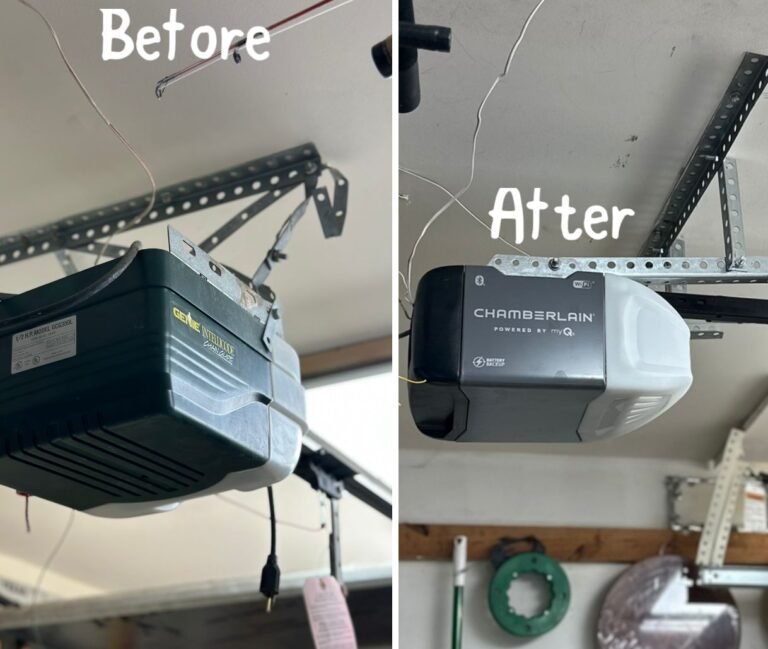
A backup battery runs the opener for a limited number of cycles with no mains power. It is not on every unit, and we’re not going to pretend it is. If you want it, say so before we fit anything and we’ll quote a model that has it. The Chamberlain in the photo below is one.
Brands and Model Numbers
The common residential ones: Chamberlain, LiftMaster, Genie, and the Craftsman openers Sears sold, which Chamberlain built. Plus the builder-grade units that come with new construction out around Katy.
If you want a straight answer on the phone, read us the model number off the label on the side of the motor housing. That one string tells us the gear, the board and whether the parts still exist — and it’s the difference between “we’ll take a look” and “we have it on the truck”.
What It Costs
The estimate is free and there is no service-call charge. A technician looks at the opener, tells you what failed and what it takes to fix it, and you decide with a firm number in front of you.
We don’t publish repair prices. A gear kit and a new opener fitted are different orders of magnitude, and quoting either one before anyone has seen the unit is a guess or a starting figure that climbs.
Parts carry a 5-year warranty and our workmanship is covered for 90 days.
Openers We’ve Fixed
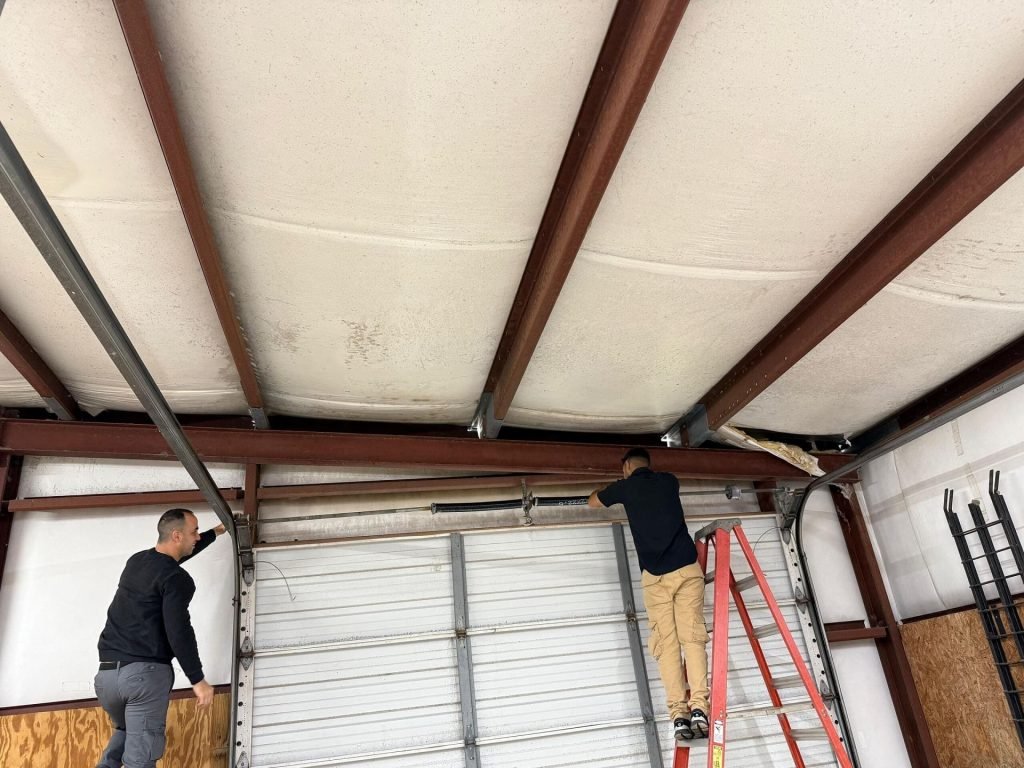
Both photos are GDF’s own. Nothing here came from a stock library.
How the Visit Goes
You call
A person picks up, day or night. Say what happens when you press the button, and read us the model number if you can reach it.
We come out
Same day for most calls. Gear kits, capacitors, sensors and remotes ride on the truck.
You get a number
Repair quoted first, and a replacement price only if repair isn’t the honest answer. Free estimate, no service-call charge.
It gets fixed
Usually the same visit. We set the travel and force limits, align the eyes, and test the safety reverse before we leave.
5.0 on Google
“Yoel came out on a Sunday about an hour after I called. My garage door was stuck halfway open and he fixed the problem in about 45 minutes. He was professional, quick, and knew exactly what he was doing. The price was very reasonable. Now my garage closes properly again and my family feels safe. Highly recommend.”
Google review
“Amazing service. They were able to identify the problem that another company couldn’t. Awesome job!”
Google review
“Thanks for coming very fast, tech Izzy replaced the spring cables and drums in less than an hour price was reasonable thanks guys, would recommend to friends and family in Katy area”
Google review · Katy, TX
Opener Questions
+My opener hums but the door doesn’t move. What is that?
Two likely causes, and they need opposite fixes. On a chain or belt opener with a plastic drive gear, the gear strips and the motor spins against nothing. That is a gear kit, and it is one of the cheaper repairs on the door.
The other cause is a broken spring: the opener is fine, but the door has become dead weight it was never built to lift. Pull the red release cord with the door fully closed and try lifting by hand. If it feels like a few hundred pounds, the problem is the spring, not the opener.
+The door starts to close, then goes back up. Why?
Almost always the two safety eyes near the floor. Something is breaking the beam, or one eye has been knocked out of line, or a lens is dirty. The opener will usually blink a light at you to say so.
Wipe both lenses, move whatever is parked in front of them, and check both are pointing at each other. That fixes it about half the time for nothing. If the beam is clear and it still reverses, it is usually the wiring or the close-force setting, and that is worth a visit.
+Can I just disconnect the safety sensors?
No, and we won’t do it either. Openers made for the US market since 1993 have to have an entrapment-protection device, and the photo eyes are it. They are the thing that stops a closing door on a child, a pet or a bike.
Holding the wall button down to force a door past its sensors bypasses that protection entirely. If the sensors are faulty, they get repaired or replaced, not removed.
+Should I repair my opener or replace it?
Repair is usually the better value on a unit under about ten or twelve years old. Gears, capacitors, sensors, remotes and wall controls are all normal parts on a machine that otherwise has plenty of life left.
Replacement makes sense when the logic board is dead on a model whose board is discontinued or costs most of a new opener, when the unit is old enough to have no photo eyes at all, or when it went under water. We tell you which of those you have before you spend anything.
+My opener died right after a storm. Is that related?
Very often, yes. A logic board is a circuit board on a household outlet, and a surge takes it out the same way it takes out anything else plugged into the wall. Houston gets plenty of chances.
The tell is a unit with no lights, no response from the wall button and no response from the remote, while the outlet itself still works. Check the outlet and the breaker first, and check whether it is on a GFCI that has tripped, because that costs nothing to rule out.
+Is a battery backup worth it?
In Houston, yes. Without one, an outage means the only way out is the release cord and lifting a heavy door by hand, and if the door is already partway up when the power goes that is not a safe thing to be doing.
A backup battery runs the opener for a limited number of cycles with no mains power. It is not standard on every unit, so if you want it, say so before we fit anything and we will quote a model that has it.
+Which opener brands do you work on?
The common residential ones: Chamberlain, LiftMaster, Genie, and the Craftsman openers that Sears sold, which Chamberlain built. We also work on the builder-grade units that come with new construction around Katy.
If yours is something unusual, read us the model number off the label on the side of the motor housing and we will tell you on the phone whether we carry parts for it.
+Do you charge to come out and look?
No. The estimate is free and there is no service-call charge. A technician looks at the opener, tells you what failed and what it takes to fix it, and you decide with a firm number in front of you.
If you would rather not go ahead, there is nothing to pay for the visit. Parts carry a five-year warranty and workmanship is covered for ninety days.
Opener Acting Up? Let’s Diagnose It.
Tell us what happens when you press the button. Free estimate, no service-call charge, and repair quoted before replacement.
Where We Come Out To
We work out of Katy and cover the metro from Cinco Ranch and the Grand Parkway east through the Energy Corridor into Houston, north to Cypress and Magnolia, and south into Sugar Land and Richmond. If you’re not sure whether you’re in range, call and ask — it’s a ten-second answer.