Garage Door Repair in Magnolia, TX
Out here the door that’s broken is as often on the shop as on the house — and a sixteen-foot opening is not a two-car garage with extra width.
What Goes Wrong Out Here
Bigger doors, longer power runs, and buildings that things live in. The failures follow.
Springs sized off a guess
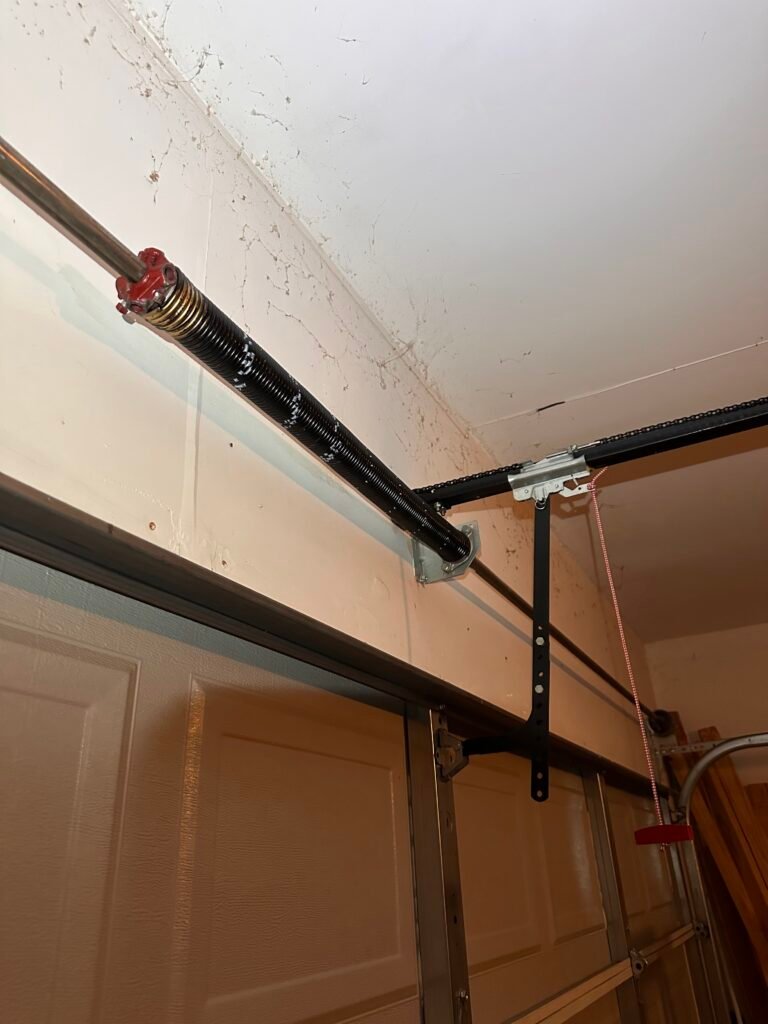
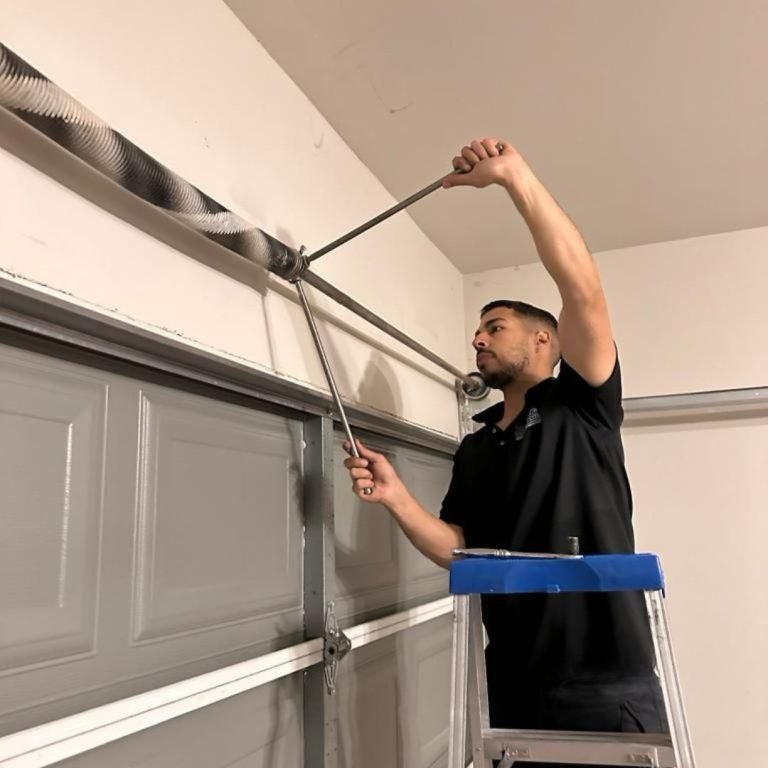
Every foot of extra width and height is weight. A spring specified for “a double door” on a sixteen-footer is a spring that comes back, usually inside a year. Spring repair →
Opener boards killed by the supply
Lightning and voltage swings take out logic boards, and the further out you are the more of it you see. Light works, wall button does nothing — that’s the board, not the motor.
Mud daubers on the sensor lens
A nest the size of a thumbnail breaks the beam and the door refuses to close. So does a spider’s web across it. Genuinely the most common non-fault we get called out to.
Chewed sensor wiring
Rodents in a shop or barn go for the low-voltage wire. It fails intermittently, which is the worst way for anything to fail, and it gets blamed on the opener every time.
Wide doors that sag in the middle
A sixteen or eighteen foot section without enough strut across it bows, and a bowed section catches on the way past. It’s the reason struts exist and the first thing to check on a wide door that’s gone rough.
Doors that live outside town
Dust, pollen, gravel and grass seed all end up in the bottom track, then in the rollers. Sweep the track; don’t grease it. Grease turns dust into grinding paste. Off-track repair →
How Long We’ll Be
Our office is on Kingsland Blvd in Katy, which puts Magnolia roughly forty-five minutes to an hour away up the Grand Parkway and across on 249. It is still same-day on most calls — the drive changes when in the day we reach you, not whether we come.
You get a real window on the phone and we hold to it. And for a shop or RV door we’ll tell you something else on that call: whether the part is one we carry or one that has to be ordered to size. Oversized springs and long track sections aren’t truck stock anywhere. Better you hear that before someone drives an hour to tell you in person.
Shop, Barn and RV Doors
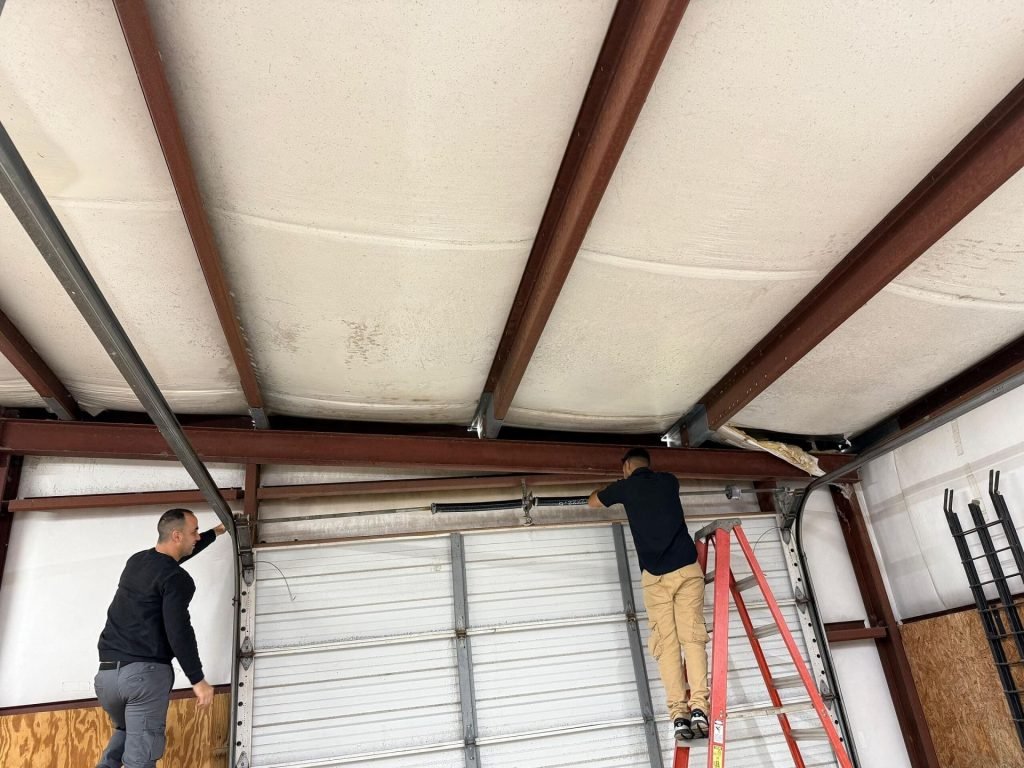
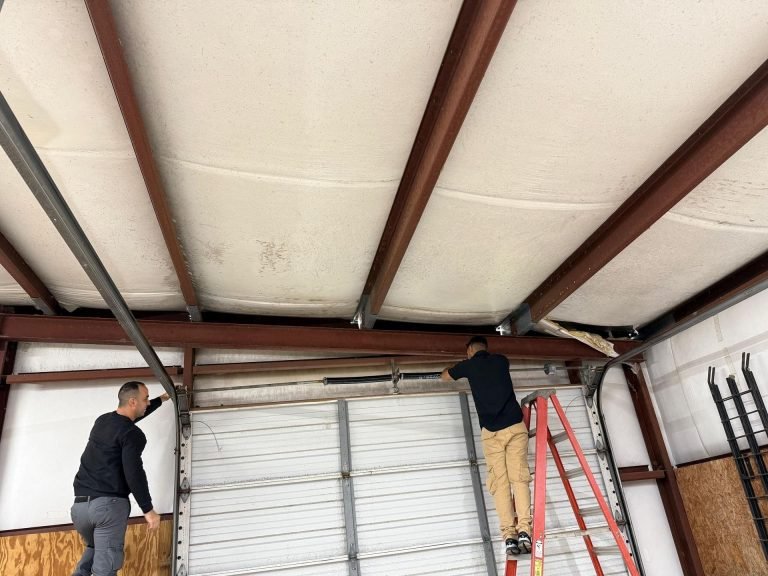
This is the part of the job that separates Magnolia from everywhere else we cover. Out here a fair share of the calls aren’t about the house at all — they’re about the detached shop, the barn, or an RV bay. Those doors run to ten and twelve feet high, sixteen and eighteen feet wide, and that is not a residential door with the numbers rounded up.
What actually changes:
- Weight, and therefore spring specification. A wider, taller door weighs a great deal more, and the spring has to be wound for what that door weighs. This is the single most common thing done wrong on an oversized door.
- Strut across the sections. A wide section without enough bracing bows in the middle. A bowed section catches, and a catching section is what pulls a door out of its track.
- Track gauge and headroom. Bigger doors want heavier track, and a shop building often has an odd amount of headroom or a low collar tie in the way. It gets measured, not assumed.
- Opener duty. A half-horse residential unit on an eighteen-foot door is a unit being asked to do a job it was never rated for, and it fails the way you’d expect. Opener options →
The first thing we ask for on any of these is the size of the opening — width and height, and how much room there is above the door. It saves a wasted visit more often than any other question.
The Power Out Here
Opener electronics have a harder life at the end of a long rural feed than they do in town. Lightning doesn’t need to hit anything nearby; a swing on the supply is enough to take out a logic board. If you’ve replaced an opener two or three times and can’t work out why, that is usually why.
Two cheap things help. A surge protector on that circuit costs very little against the unit it protects. And when a unit is being replaced anyway, get one with battery backup — losing power with a door open matters more on a property with a long drive and a gate than it does on a suburban street.
Check these two before you call anyone
The sensor lenses. If the door starts down and reverses, look at the two little eyes near the floor at each side. A mud dauber nest, a web, or a splash of mud is enough. Wipe them, check the small lights are steady, and try again.
Sensor alignment. A knock from a mower, a trailer or a wheelbarrow moves a bracket and the two eyes stop seeing each other. Both of those are five-minute fixes and we’d rather tell you on the phone than charge you for the drive.
Insulation on a Shop Door
Asked often enough to answer properly. If you actually use the shop — work in it, keep something in it that minds the temperature — then yes, usually worth it. If it’s storage, usually not.
The honest caveat: the number on the box is the R-value of the panel, not of the building. An insulated door on an uninsulated metal shop with daylight showing under it will not do much, and anyone selling it to you as though it will is selling. What an insulated section does do regardless of the building is stiffen the door, and on a sixteen or eighteen foot opening that stiffness is worth having on its own. New door installation →
What It Costs
The estimate is free and there is no service-call charge, and that holds this far out too. A technician looks at the door, tells you what failed and what it takes to fix it, and you decide with a firm number in front of you.
We don’t publish repair prices, and on oversized doors a published price would be meaningless. A spring for a seven-foot single and a spring for an eighteen-foot shop door are different parts with different specifications; quoting one figure for both would just be a starting number that climbs.
Parts carry a 5-year warranty and our workmanship is covered for 90 days.
Our Own Work
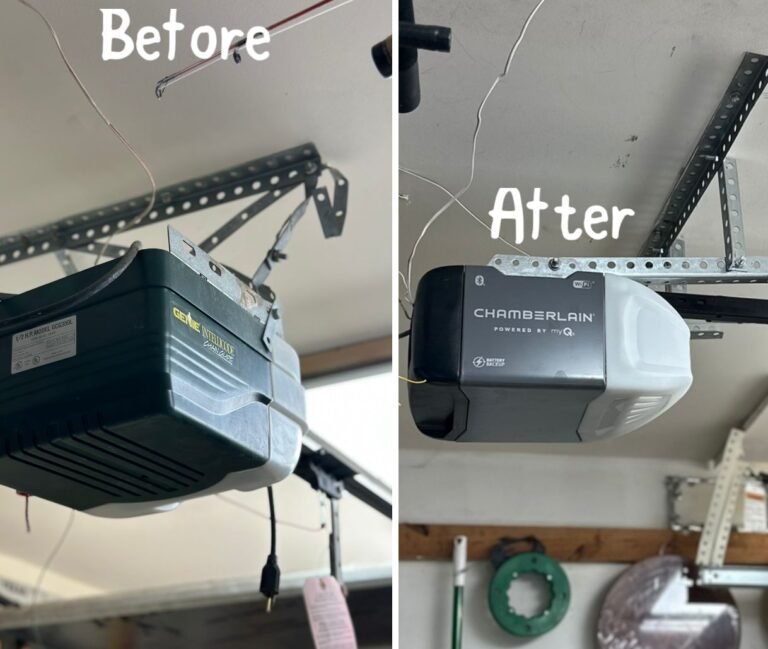
Photos from our own calls around the Houston area. Nothing here came from a stock library.
How the Visit Goes
You call
A person picks up, day or night. Say whether it’s the house or the shop, and roughly how big the opening is.
You get a real window
Same-day on most calls. Forty-five minutes to an hour from the office, so it usually lands later in the day — you get a window we can hold.
You get a number
A firm price before any work starts. Free estimate, no service-call charge, no obligation to go ahead.
It gets fixed
Same visit for the common parts. Oversized springs and long track sometimes need ordering to size — and we tell you that on the phone, not on the driveway.
5.0 on Google
“Fast, Fair, and great Quality! Highly recommend to use them for your garage door needs.”
Google review
“Great price — Fast, reliable, and very affordable! Our garage door spring broke unexpectedly, and Izzy, the owner came out the same day. Fixed the issue quickly and the price was very reasonable and lower than other companies. Highly recommend this company to anyone needing quick and honest repair work!”
Google review
“Called Saturday morning and Tech Izzy came same day and repaired my garage door within 20 minutes. Price was affordable. I would definitely recommend this guys.”
Google review
Magnolia Questions
+How soon can you get out to Magnolia?
Yes, on most calls. It is roughly forty-five minutes to an hour from the office in Katy, up the Grand Parkway and across on 249, so Magnolia usually lands later in the day rather than first thing.
You will get a window we can hold, and we will tell you on the phone whether the part is one we carry — which matters more here than anywhere else we cover, because oversized shop and RV hardware often has to be ordered to size.
+Do you do shop and barn doors, not just the house?
Yes, and out here it is often the bigger job. Detached shops, barns and RV bays run wider and taller than a house door — ten and twelve feet high, sixteen and eighteen feet wide is ordinary — and every foot of width and height is weight the springs have to be sized for. The first thing we ask for is the size of the opening, because a spring specified off a guess is a spring that comes back.
+My opener has died three times in five years. Is that normal?
It is common out here and it is usually the supply, not the opener. Lightning and voltage swings kill logic boards, and the further out you are the more of it you see. A surge protector on that circuit is cheap insurance. If the unit is being replaced anyway, get one with battery backup — losing power with a door open matters more on a property with a long drive and a gate than it does in town.
+The safety sensors keep stopping the door halfway down.
Check the lenses first. Mud daubers build on them, spiders web across them, and a nest the size of a thumbnail is enough to break the beam. After that it is alignment: a knock from a mower, a trailer or a wheelbarrow moves a bracket and the two eyes stop seeing each other. Both are five-minute jobs, and if that is what it sounds like on the phone we will tell you so you can try it before we drive out.
+Something has chewed the wiring in the shop. Can that be the fault?
Very often, yes. Chewed sensor wire is the classic one in a shop or barn building, and it fails intermittently, which is the most annoying way for anything to fail. If the door works some days and not others and there is any sign of rodents, that is where to look before anyone replaces an opener that is fine.
+Is an insulated door worth it on a shop?
If you use the shop, usually. If it is storage, usually not. The number on the box is the R-value of the panel, not of the building — an insulated door on an uninsulated metal shop with daylight under it does very little. What it does do regardless is stiffen the section, and that matters more on a sixteen or eighteen foot opening than on a single-car door.
+We have a gate and a long gravel drive. Anything you need to know?
Just tell us when you call. A gate code, a dog, or a drive a loaded van should not attempt after heavy rain are all worth thirty seconds on the phone. It is the difference between a technician arriving and a technician arriving and turning around.
+Do you charge to come out and look?
No. The estimate is free and there is no service-call charge, and that holds this far out too. A technician looks at the door, tells you what failed and what it takes to fix it, and you decide with a firm number in front of you. If you would rather not go ahead, there is nothing to pay for the visit.
Shop Door Down in Magnolia?
Tell us the size of the opening and what it’s doing. Free estimate, no service-call charge, and a straight answer about parts.
Around Magnolia and Out to the Acreage
Both Magnolia zips, in town and out on the land — Lake Windcrest, High Meadow Estates, Mostyn Manor, Ranch Crest, Clear Creek Forest and the properties off Nichols Sawmill and FM 1774 — plus Pinehurst, Decker Prairie, Stagecoach, Todd Mission, Hockley and Tomball around the edges. If you’re further out than that, call and ask rather than assuming; we’ll give you a straight answer. See the whole service area →