
How Long Do Garage Door Springs Last? (It’s Not Measured in Years)
Your neighbour’s door is fifteen years old and fine. Yours went at six. Neither of you got unlucky — you’re just measuring the wrong thing.
It’s the question we get asked more than any other, usually about ten minutes after we’ve finished replacing one.
The answer people expect is a number of years. The honest answer is that years are the wrong unit, and once you know the right one, everything else about springs makes sense.
Springs Are Rated in Cycles
One cycle is the door going up once and coming down once. That’s it. A spring doesn’t care how long it’s been on your wall — it cares how many times it’s been twisted and untwisted.
A standard builder-grade torsion spring is rated for about 10,000 cycles. That number is the one thing worth remembering, because it turns a vague question into arithmetic:
- Twice a day — out in the morning, back in the evening — is around 13 years.
- Four times a day, which is a normal two-driver household, is around 7 years.
- Eight times a day — teenagers, a home business, a garage used as the front door — is around 3–4 years.
Same spring, same street, same builder. Three very different lifespans. That’s the whole mystery solved: the neighbour whose door is still fine after fifteen years parks on the driveway and barely uses the garage.
Which is why the garage-as-front-door thing matters
Around Katy and the newer Houston subdivisions, a lot of houses are laid out so the garage is the everyday entrance. Nobody uses the front door except guests. If that’s your house, your door is doing six, eight, ten cycles a day without anyone thinking about it, and a 10,000-cycle spring is going to be a four-year part. Not a defect. Just arithmetic.
Why It Broke With No Warning
Because that’s what springs do, and anyone who tells you otherwise is overselling their inspection.
A torsion spring is a length of steel being wound and unwound under serious load. The metal fatigues gradually, invisibly, from the inside, until one cycle is the one it can’t complete. Nothing looks different the day before. This is genuinely different from cables, which fray visibly over months and give you a real chance to catch them.
There are a few soft indicators worth knowing, with the honest caveat that plenty of springs show none of them:
- The door has started feeling heavier by hand with the opener released.
- It jerks or hesitates part-way up rather than running smoothly.
- You can see gaps opening between the coils on the spring at rest.
- Rust or flaking along the coil — which is its own problem, below.
The Humidity Problem
Cycle count is the main story, but around here there’s a second one.
Rust on a torsion spring increases the friction between coils as they wind, and that accelerates metal fatigue. A garage that stays damp — which, along the Gulf Coast, means most garages for a good part of the year — rusts hardware faster than a dry climate does. Closer to the water, in Galveston and the bay side of League City, salt in the air makes it faster again.
The fix is genuinely trivial and genuinely works: a light spray of garage-door lubricant along the spring once or twice a year. Not WD-40 — that’s a solvent and it strips what’s there. A proper silicone or lithium garage-door spray. It’s one of the very few maintenance jobs on a garage door that is both completely safe to do yourself and actually worth the ten minutes.
Is a High-Cycle Spring Worth Paying For?
Sometimes. Here’s the honest version rather than the sales version.
A high-cycle spring is wound from thicker wire with a larger inside diameter, so it does the same work with less stress per cycle. Ratings typically run 20,000 to 50,000 cycles against the standard 10,000. It costs more up front.
Worth it if: your garage is the household’s main entrance, you’re running six or more cycles a day, or you’ve already replaced a spring once and don’t fancy doing it again on the same schedule.
Not worth it if: the door goes up in the morning and down at night. At two cycles a day a standard spring is already a 13-year part, and paying to extend that to 40 years is buying something neither you nor the door will ever use. We’ll tell you that on the driveway.
The One Job We’d Rather You Didn’t Do Yourself
We give away DIY fixes on this blog wherever they’re real — the blinking sensor light is usually a free two-minute job and we say so.
This is the exception, and it’s the only flat no we’ll give you.
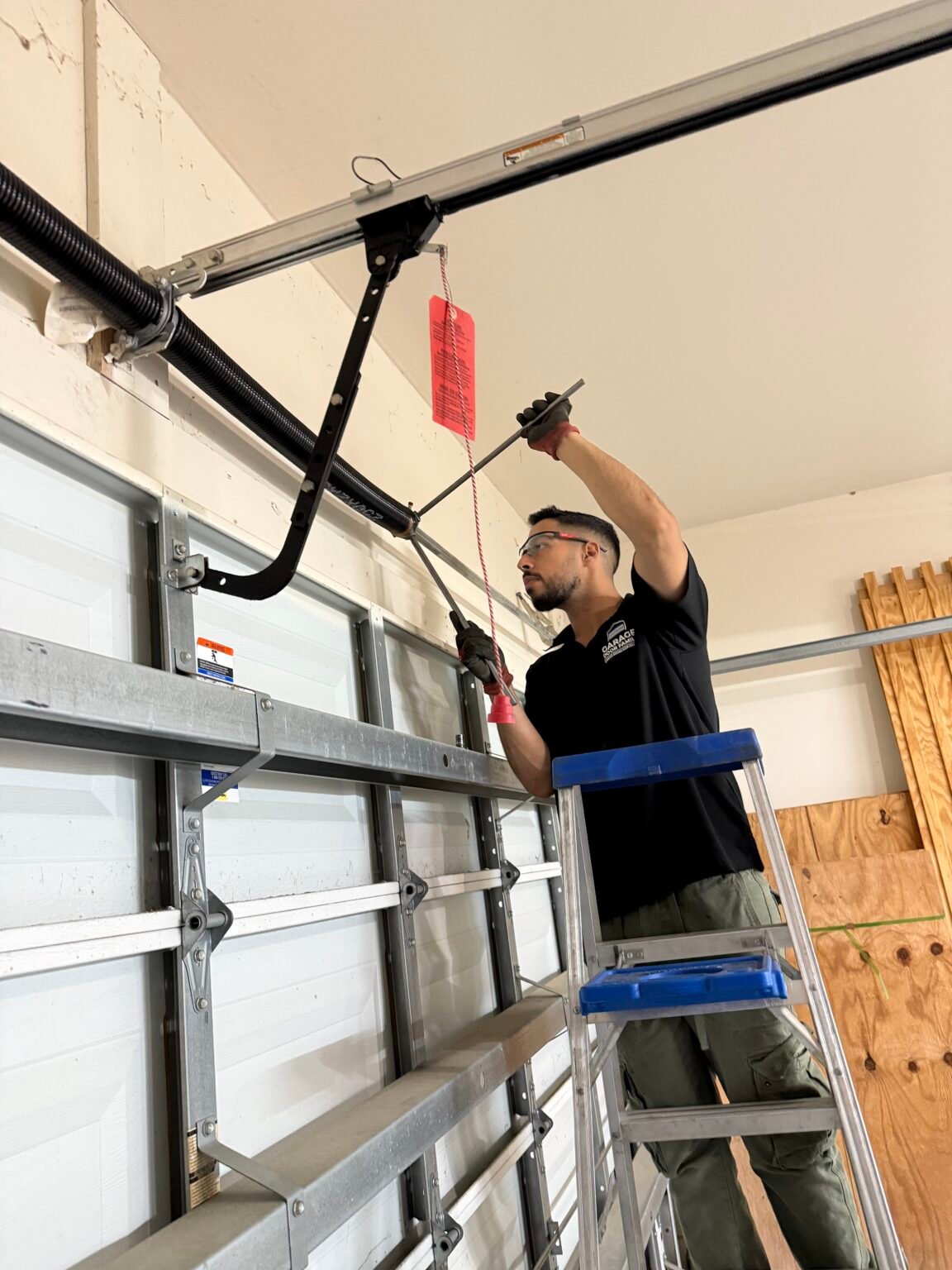
A torsion spring holds several hundred pounds of stored energy. Releasing it takes winding bars, in a specific sequence, with the door in a specific position. If a bar slips it becomes a projectile, and the door becomes a falling weight. Nearly every serious garage door injury on record involves a spring. There is no version of this where the money saved is worth the outcome when it goes wrong.
Almost everything else on your door is a reasonable thing to try. Not this.
Spring Questions We Get Daily
+How long do garage door springs last?
Springs are rated in cycles, not years. One cycle is the door going up once and down once. A standard builder-grade torsion spring is rated for about 10,000 cycles. If your household opens the door four times a day that works out at roughly seven years; at eight times a day it is more like three and a half. That is why two identical doors on the same street can be years apart — it is not age that wears a spring out, it is use.
+Why did my spring break when the door was working fine yesterday?
Because a spring gives almost no warning. It is a length of steel being twisted and untwisted thousands of times, and the metal fatigues gradually until one cycle is the one it cannot do. Nothing looks different the day before. This is why springs are the one garage door part that genuinely fails out of nowhere, and why a door that has behaved perfectly for a decade can quit on an ordinary Tuesday morning with a car shut inside.
+What is a high-cycle spring and is it worth it?
A high-cycle spring is wound from thicker wire with a larger inside diameter, which lets it do the same work with less stress per cycle. Ratings usually run 20,000 to 50,000 cycles against the standard 10,000. It costs more up front and it is genuinely worth it in two situations: a household that opens the door many times a day, and a garage that is the main entrance to the house rather than somewhere the car sits overnight. For a door used twice a day it is money you do not need to spend.
+Should both springs be replaced if only one broke?
Yes. On a two-spring door both springs are the same age and have done the same number of cycles, so if one has reached the end of its life the other is within months of the same place. Replacing one means paying for the same call-out twice, and an unbalanced pair also makes the door pull unevenly. We replace them in pairs as standard, the same way we replace cables in pairs.
+How can I tell if my spring is about to go?
Mostly you cannot, and anyone promising a reliable warning sign is overselling it. There are a few soft indicators worth knowing: a door that has started feeling heavier by hand with the opener released, a door that jerks or hesitates part-way up, visible gaps opening between coils on the resting spring, and rust or flaking along the coil, which shortens life. But plenty of springs give none of these and simply break.
+Does Houston weather shorten spring life?
Humidity does, indirectly. Rust on a torsion spring increases friction between the coils and accelerates metal fatigue, and a garage that stays damp — which around here means most of them for part of the year — rusts hardware faster than a dry climate would. Near the coast, in Galveston and the bay side of League City, salt in the air makes it faster again. Spraying the spring lightly with a garage-door lubricant once or twice a year genuinely helps, and it is one of the few maintenance jobs that is both safe and worth doing.
+Can I replace a garage door spring myself?
This is the one job on a garage door where the honest answer is no. A torsion spring holds several hundred pounds of stored energy and it is released with winding bars in a specific sequence. If it slips, the bar becomes a projectile and the door becomes a falling weight. Nearly every serious garage door injury involves a spring. Almost everything else on a door is a reasonable thing to try yourself; this one is not.
+What does a broken spring look like?
Look at the steel bar running along the wall above the door. A torsion spring that has failed shows a clean gap of an inch or two in the middle of the winding where the two ends have separated. That gap is the whole diagnosis. The other signals are a bang loud enough to wake the house with nothing obviously wrong afterwards, an opener that strains and lifts the door only a few inches before giving up, and a door that is suddenly far too heavy to lift by hand.
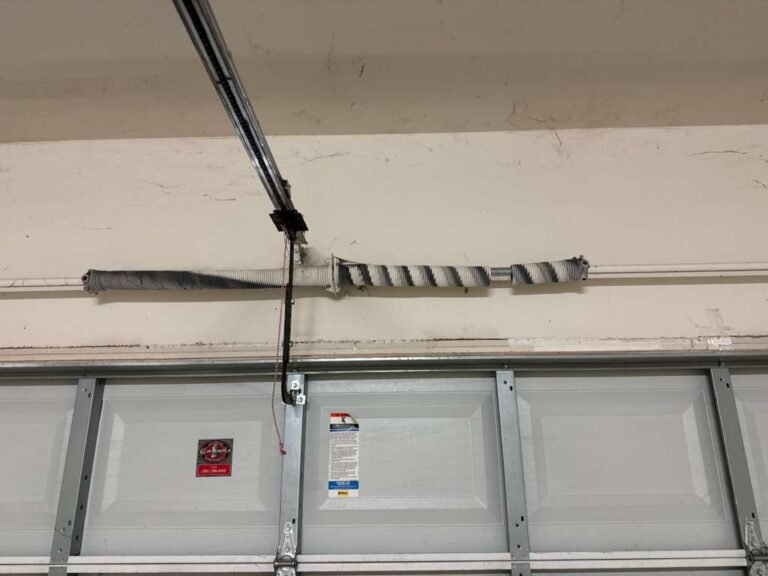
Gap in the Coil?
That’s the diagnosis. Leave the door down and give us a call — free estimate, no service-call charge, and springs replaced in pairs.